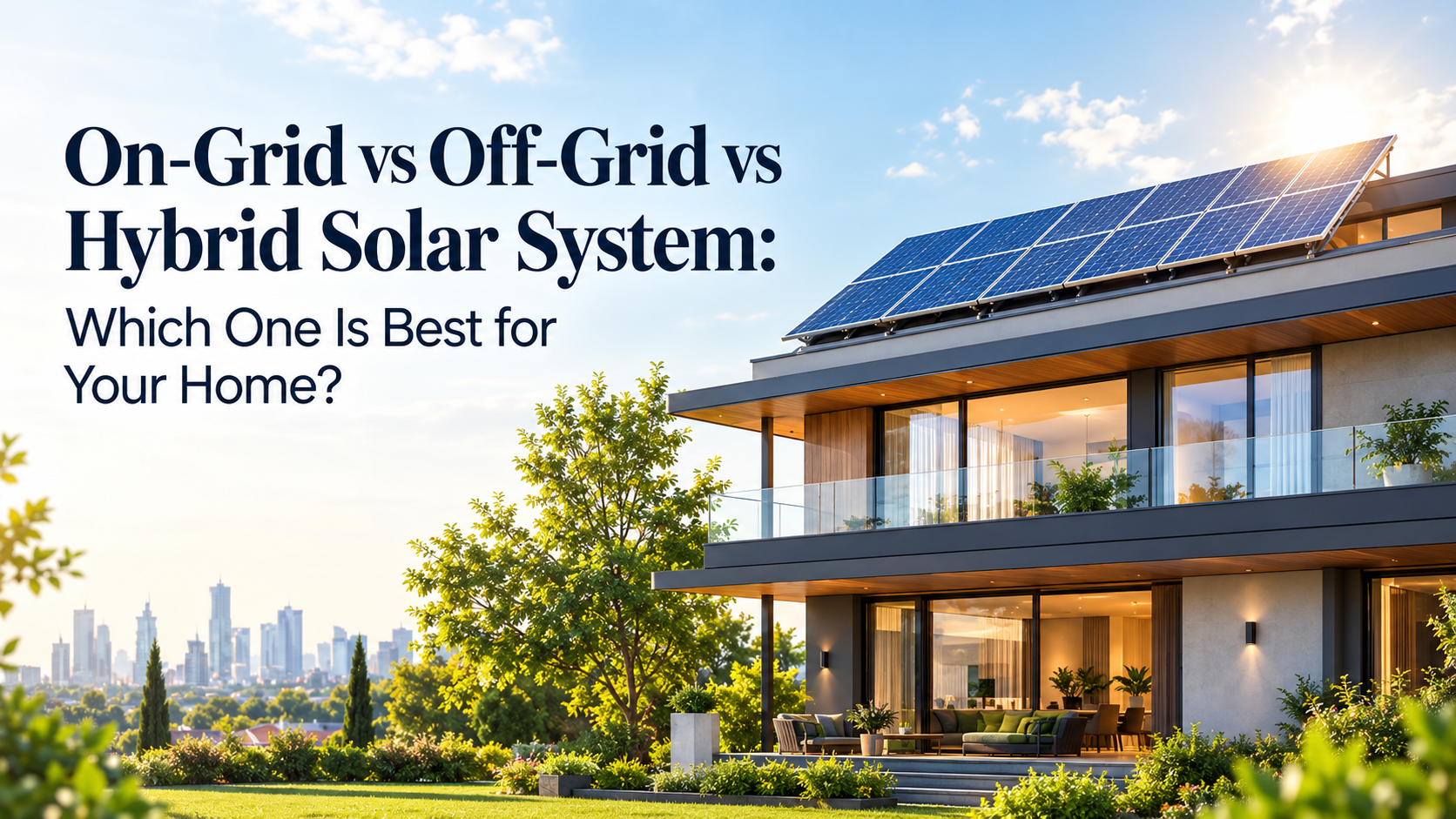
On-Grid vs Off-Grid vs Hybrid Solar System: Which One Is Best for Your Home?
Compare on-grid, off-grid, and hybrid solar systems to understand their costs, benefits, backup power, net metering, and which option is suitable for your home.
On-Grid vs Off-Grid vs Hybrid Solar System: Which One Is Best for Your Home?
Going solar isn't merely an environmentally friendly option any longer, it's a financial move that can reduce your electricity bills by 70 to 90 per cent. However, before you install a single panel, you'll have to answer one important question: which kind of solar system is suitable for your house?
The three principal choices are on-grid, off-grid, and hybrid solar systems. They function in different ways, meet different requirements, and each has its own set of advantages and disadvantages when it comes to cost, backup power, and independence from the utility grid. Selecting the incorrect option could result in you paying more than necessary for capacity that you never actually need or leave you without power when there's a power cut.
The guide explains how each system works, examines their actual advantages and disadvantages, and tells you which system is the most appropriate for your house and financial situation.
On-Grid Solar System
The most common and cost-effective arrangement for urban houses that have reliable access to the grid is one that is connected to it.
Solar panels produce electricity during the day and use it directly to power your home. Any extra energy is sent to the utility grid via net metering and this gives you credits on your electricity bill.
Pros
- Lowest upfront cost since there's no battery involved
- Fastest payback period, typically 3-5 years
- Solar power generated can be exported to the EB grid and stored as credits for future use. These credits are valid only for the financial year (April–March).
- Minimal maintenance and fewer components to manage
Cons
- There is no backup in the case of a power cut; the system shuts down automatically when the power grid fails for safety reasons.
- Complete dependence on grid stability
- Not ideal for areas with frequent outages
Off-Grid Solar Power Systems
In places that are remote or where the power grid connection is poor, off-grid solar power systems provide a fully self-sufficient means of meeting energy needs.
Off-grid solar power systems function completely without being connected to the utility grid. During the day, the panels charge a battery bank, after which the stored energy is used to power the house at all times. The system has to be designed to meet 100% of the household's energy requirements, including having backup during long periods of cloudiness.
Pros
- Total energy independence with no reliance on the utility company
- Ideal for remote or off-grid locations without grid infrastructure
- Immune to grid outages and blackouts
Cons
- High upfront investment due to large battery banks
- No net metering, since there's no grid connection to sell excess power to the grid
- Requires careful load management and larger system sizing
- Batteries need periodic replacement, adding to long-term costs
On-Grid Hybrid Solar System
If you wish to have the best of both worlds, then an on-grid hybrid solar system combines connection to the grid with battery backup, thus providing both savings and security.
Here's how it works: The hybrid system is connected to the grid in the same way as an on-grid system, but it also has a battery. During the day, the solar power is used to run your home and at the same time charges the battery; when the grid fails the battery switches on automatically and continues to power your essential appliances without any interruption.
Pros
- Uninterrupted power supply even during outages
- Still eligible for net metering credits
- Reduces battery costs compared to full off-grid systems, since the grid handles overflow demand
- Flexible and scalable batteries can be added or upgraded later
Cons
- Slightly longer payback period due to battery investment
- Requires a smart hybrid inverter, which adds to system complexity
Comparison Table: On-Grid vs Off-Grid vs Hybrid
| Feature | On-Grid | Off-Grid | Hybrid (On-Grid Hybrid) |
|---|---|---|---|
| Grid Connection | Yes | No | Yes |
| Battery Storage | No | Yes (large capacity) | Yes (moderate capacity) |
| Power Cut Functionality | No backup | Full backup | Full backup for essential loads |
| Net Metering | Yes | Not applicable | Yes |
| Subsidy Eligibility | Yes (government schemes) | Limited/varies by region | Yes (in most regions) |
| Payback Period | 3-5 years | 7-10 years | 5-7 years |
So, which solar system should you select?
The right choice depends on your grid reliability, budget, and backup power needs:
- Go with On-Grid if you are in a city that has reliable electricity and are looking for the fastest return on your investment; it is the cheapest way to get started with solar.
- Go for Off-Grid if you live in a remote area where there is no access to the power grid or if you want to be completely independent of the utility company provided that you are willing to pay the higher initial cost.
- If you suffer from occasional power outages and would like the financial advantages of net metering together with the security provided by a battery backup, then you should select the On-Grid Hybrid system. For the majority of home owners who are looking to achieve a balance between cost savings and reliability, this is becoming the wiser choice for the long term.
If you're still not sure which system is right for your home, why not get a free consultation with our solar experts who will then produce a customized system design taking into account your energy consumption, the space available on your roof, and the local grid conditions and begin saving from the very first day.